Understanding Promises in JavaScript
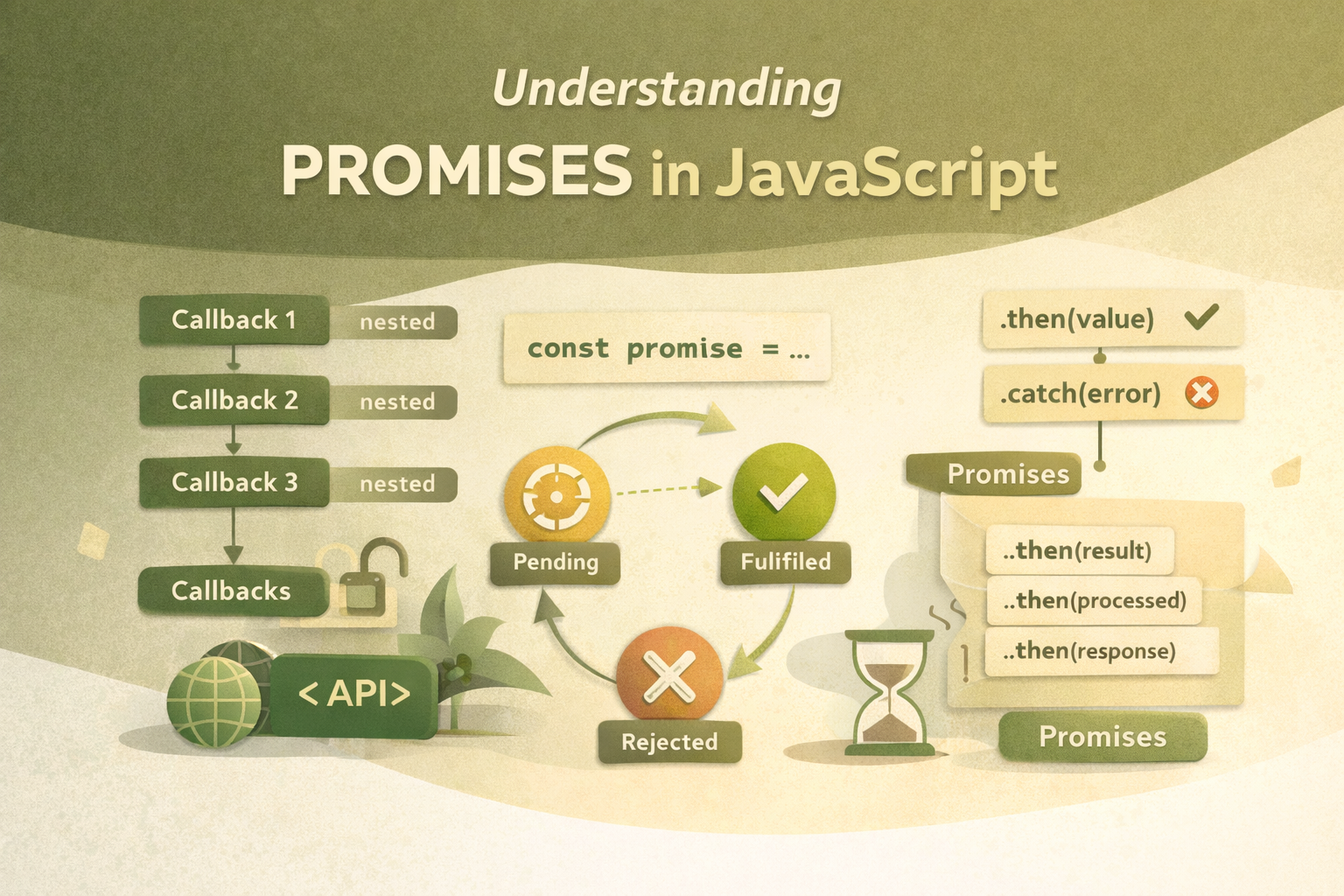
JavaScript is inherently asynchronous, which means it often deals with operations that take time to complete, such as API calls, file handling, or timers. Initially, developers relied on callbacks to handle these operations, but this approach quickly became difficult to manage as applications grew in complexity. Promises were introduced to solve these problems and provide a cleaner, more structured way to handle asynchronous code.
This article explains promises in depth, including their purpose, lifecycle, states, and how they improve code readability compared to callbacks.
What Problem Do Promises Solve
Before promises, asynchronous operations in JavaScript were primarily handled using callbacks. While callbacks work, they can lead to deeply nested structures when multiple asynchronous operations depend on each other. This problem is commonly referred to as "callback hell."
Example of Callback Hell
getUser(function(user) {
  getOrders(user.id, function(orders) {
    getOrderDetails(orders[0], function(details) {
      console.log(details);
    });
  });
});
Explanation
In this example, each function depends on the result of the previous one, leading to nested callbacks. As the number of operations increases, the code becomes harder to read, debug, and maintain.
Promises solve this problem by providing a more structured way to handle asynchronous operations. They allow chaining and better error handling, making the code cleaner and easier to understand.
Promises as a Future Value
A promise represents a value that may not be available immediately but will be resolved at some point in the future. It acts as a placeholder for the eventual result of an asynchronous operation.
Instead of passing callbacks into functions, promises return an object that you can attach handlers to, using methods like .then() and .catch().
This makes the flow of data more predictable and easier to follow.
Promise States
A promise can be in one of three states:
Pending
Fulfilled
Rejected
Explanation
When a promise is created, it starts in the pending state. This means the asynchronous operation is still in progress.
If the operation completes successfully, the promise moves to the fulfilled state, and the result becomes available.
If the operation fails, the promise moves to the rejected state, and an error is returned.
These states are mutually exclusive, and once a promise is fulfilled or rejected, its state cannot change.
Basic Promise Lifecycle
The lifecycle of a promise describes how it moves from creation to resolution or rejection.
Example
const promise = new Promise((resolve, reject) => {
  const success = true;

  if (success) {
    resolve("Operation successful");
  } else {
    reject("Operation failed");
  }
});
Explanation
When the promise is created, it is in a pending state. Inside the executor function, either resolve or reject is called depending on the outcome.
If resolve is called, the promise is fulfilled. If reject is called, the promise is rejected.
This lifecycle ensures that every asynchronous operation has a clear outcome.
Handling Success and Failure
Promises provide built-in methods to handle success and failure in a structured way.
Example
promise
  .then(result => {
    console.log(result);
  })
  .catch(error => {
    console.log(error);
  });
Explanation
The .then() method is used to handle successful resolution of the promise. It receives the resolved value as an argument.
The .catch() method is used to handle errors or rejected promises. It receives the error as an argument.
This separation of success and failure handling improves clarity and avoids mixing logic.
Promise Chaining Concept
One of the most powerful features of promises is chaining. It allows multiple asynchronous operations to be executed in sequence without nesting.
Example
fetch("https://api.example.com/user")
  .then(res => res.json())
  .then(user => fetch(`https://api.example.com/orders/${user.id}`))
  .then(res => res.json())
  .then(orders => console.log(orders))
  .catch(error => console.log(error));
Explanation
Each .then() returns a new promise, allowing the next .then() to use its result. This creates a chain of operations that are easy to read and maintain.
If any step in the chain fails, the error is automatically passed to the .catch() block.
This eliminates the need for repetitive error handling at each step.
Promises vs Callbacks
Promises significantly improve code readability and maintainability compared to callbacks.
Callback Approach
getData(function(result) {
  processData(result, function(processed) {
    saveData(processed, function(response) {
      console.log(response);
    });
  });
});
Promise Approach
getData()
  .then(result => processData(result))
  .then(processed => saveData(processed))
  .then(response => console.log(response))
  .catch(error => console.log(error));
Explanation
In the callback approach, functions are nested, making the code harder to follow. In the promise-based approach, operations are chained linearly, making the flow clear and readable.
Promises also centralize error handling, whereas callbacks often require error handling at each level.
Key Advantages of Promises
Promises offer several advantages over traditional callback-based approaches.
They improve readability by flattening nested code structures. They provide better error handling through a centralized .catch() block. They make asynchronous flows easier to reason about and maintain.
Additionally, promises serve as the foundation for modern JavaScript features such as async/await, which further simplify asynchronous programming.
Conclusion
Promises are a fundamental concept in JavaScript that address the limitations of callbacks. By representing future values and providing structured methods for handling success and failure, they make asynchronous code more readable and maintainable.
Understanding promises is essential for modern JavaScript development, as they are widely used in APIs, frameworks, and libraries.